| Path | Who it covers | Test |
|---|---|---|
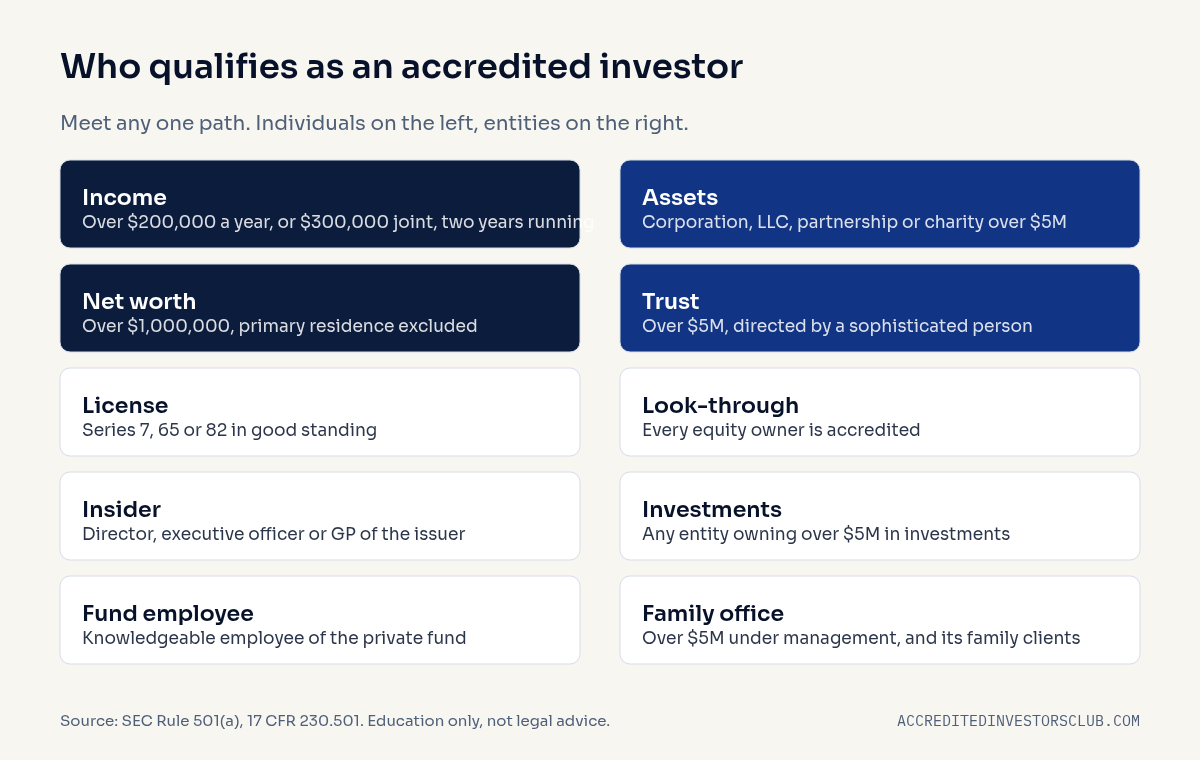
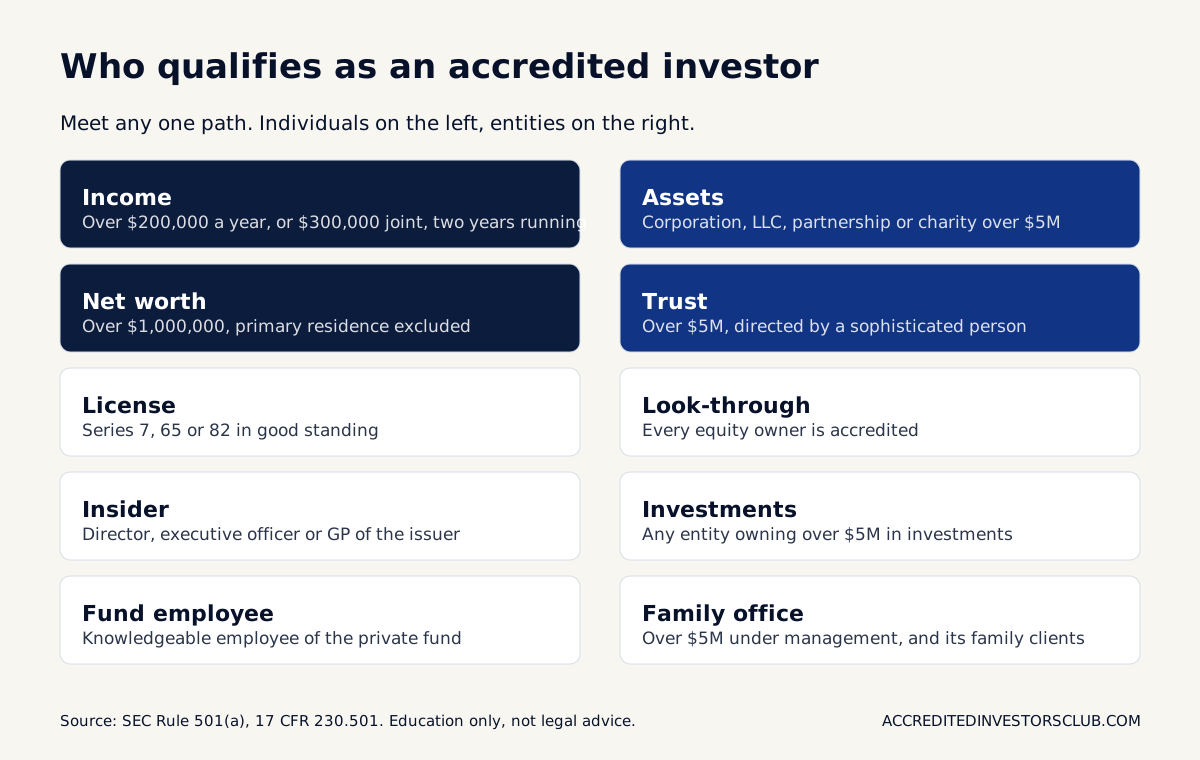
| Income | Individuals | Over $200,000 a year, or $300,000 joint, in each of the last two years, expecting the same this year |
| Net worth | Individuals, alone or with a spouse or spousal equivalent | Over $1,000,000, primary residence excluded |
| Professional license | Individuals | Series 7, Series 65 or Series 82 in good standing |
| Knowledgeable employee | Employees of a private fund | For investments in that fund |
| Insider | Directors, executive officers, general partners | For that issuer's offering |
| Entity assets | Corporations, LLCs, partnerships, charities | Total assets over $5,000,000, not formed to invest |
| Trust | Trusts | Over $5,000,000, directed by a sophisticated person |
| Look-through | Any entity | Every equity owner is accredited |
| Investments | Other entities | Over $5,000,000 in investments |
| Family office | Family offices and their family clients | Over $5,000,000 under management |
The two financial tests for individuals
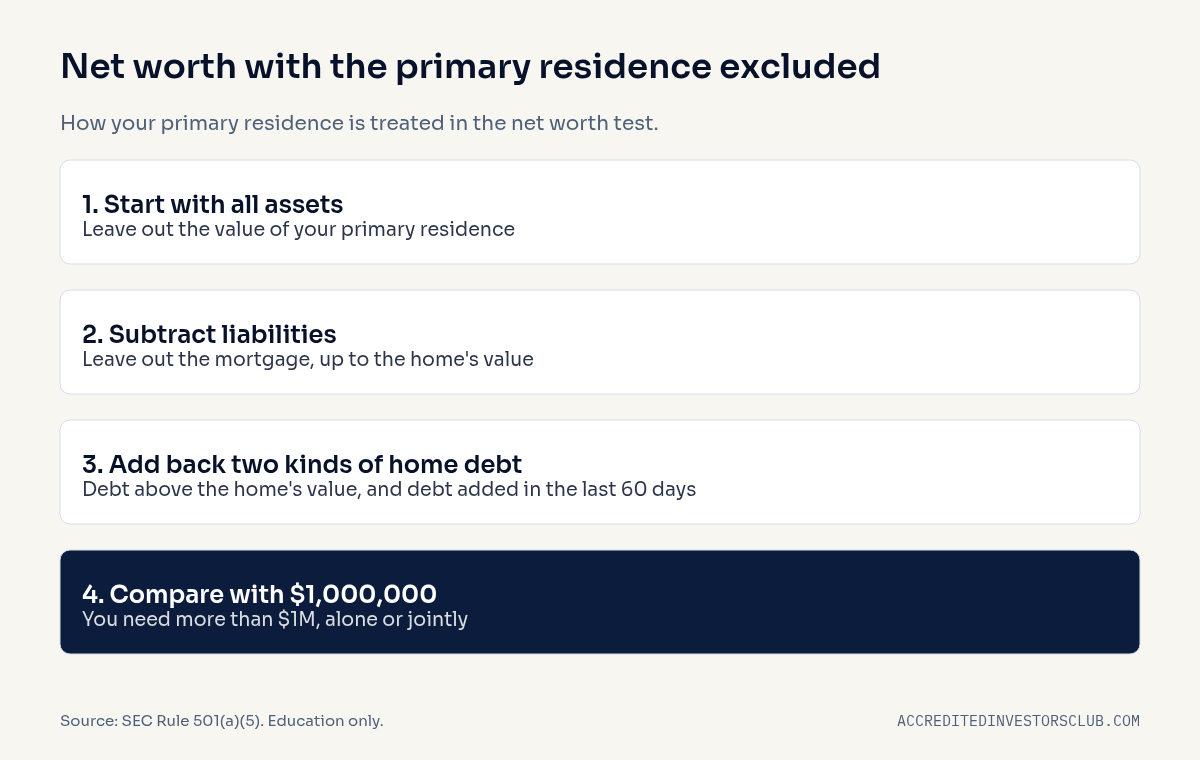
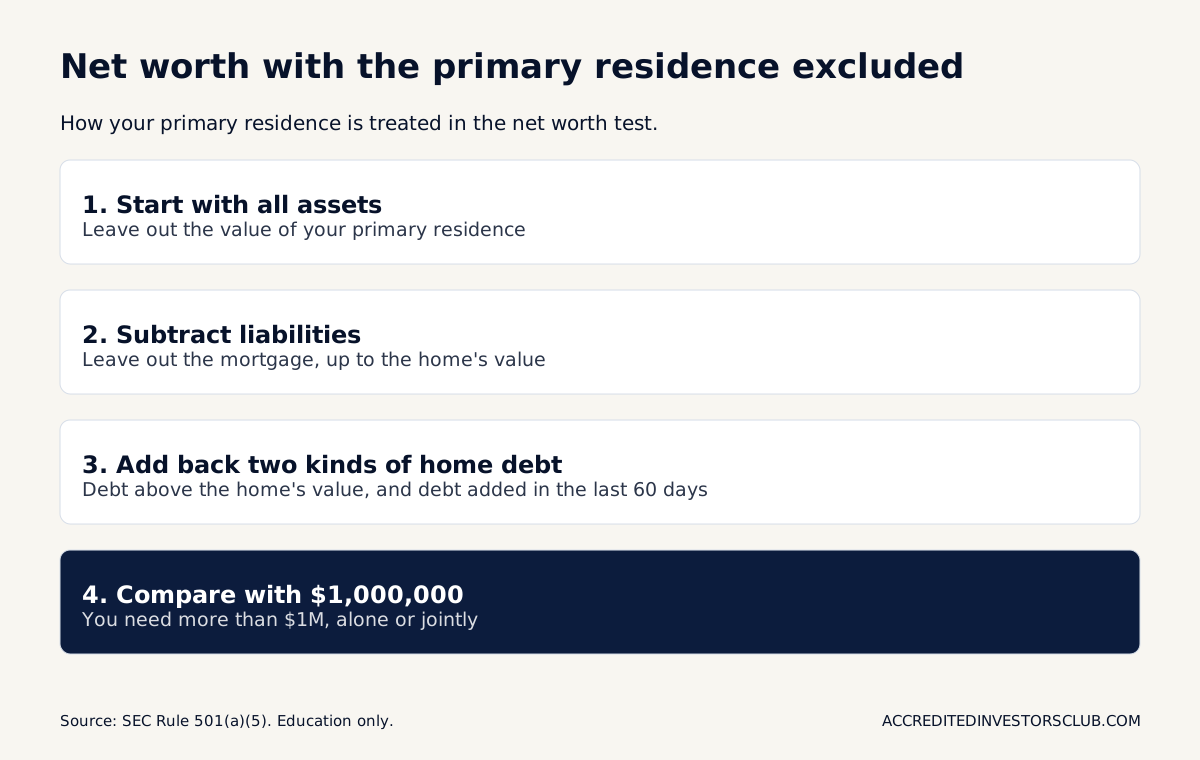
The first test looks at net worth. You qualify with a net worth over $1,000,000, alone or jointly with a spouse or spousal equivalent. Your assets do not need to be held jointly to count, and the securities do not need to be bought jointly. Your primary residence is not counted as an asset. Mortgage debt on it, up to the home's fair market value, is not counted as a liability. Debt above the home's value does count. So does debt added in the 60 days before the sale, unless it was used to buy the home.
The second test looks at income. You qualify with income over $200,000 in each of the two most recent years. As a couple, the figure is over $300,000 in each of those years. You also need a reasonable expectation of reaching the same level this year. The SEC's spousal equivalent is a cohabitant in a relationship generally equivalent to that of a spouse. A speaker at a Family Office Club event pointed out that this means you no longer need to be married to use the joint income test.
The table on this page shows both tests side by side. For a friendly overview, see Who Qualifies as an Accredited Investor? A Welcoming Guide.
Qualifying through a license or a role
You do not need to meet a dollar test if you hold certain credentials or roles.
- Holders in good standing of the Series 7, Series 65 or Series 82 license qualify.
- Knowledgeable employees of a private fund qualify for investments in that fund.
- Directors, executive officers and general partners of an issuer, or of its general partner, qualify for that issuer's offering.
A speaker at a Family Office Club event noted that the license list is narrow. Many people with other professional degrees do not fit it. The same speaker added that the SEC kept the right to expand the definition by order, so it may grow over time.
Entities, trusts and family offices
The chart on this page shows the $5,000,000 line that appears across many entity types. Corporations, LLCs, partnerships, business trusts and 501(c)(3) organizations qualify with total assets over $5,000,000, as long as they were not formed to buy the securities. Trusts with total assets over $5,000,000 qualify too, if a sophisticated person directs the purchase. A revocable trust may also qualify when its grantors are accredited.
Other routes include:
- Any entity in which all equity owners are accredited investors.
- Other entity types owning investments over $5,000,000.
- Family offices with assets under management over $5,000,000, and their family clients.
- Banks, registered broker-dealers, registered and exempt reporting investment advisers, insurance companies and certain plans with assets over $5,000,000.
Learn more in Entities That Qualify as Accredited Investors and Trusts and Accredited Investor Status.
Why the numbers look the way they do
The individual net worth and income figures have not been indexed for inflation since they were set. Net worth and income date to 1982, and joint income to 1988. Dodd-Frank removed the primary residence from net worth and asks the SEC to review the definition every four years. A staff review estimated that about 18.5% of US households met the financial thresholds in 2022. In 1983 it was about 1.8%.
Frequently asked questions
Do I need to meet both the income test and the net worth test?
No. Meeting either one is enough. A professional license or a qualifying role can also work on its own.
Is my home counted toward the $1,000,000 net worth?
No. Your primary residence is excluded as an asset. Mortgage debt on it up to its fair market value is not counted against you. Debt above that value is counted.
What if I do not qualify yet?
You still have options. Some offerings under Rule 506(b) may accept a limited number of sophisticated non-accredited purchasers. Read Non-Accredited Investors in 506(b) Deals to learn how that works.

Related reading
- Accredited Investor Test Calculator
- Net Worth Calculator Excluding Your Primary Residence
- Qualified Purchaser Investments Calculator
- Qualified Client Test Calculator
- Preferred Return and Waterfall Calculator
- Capital Call and Liquidity Planner
This site is built from over 19 years of Family Office Club workshops, bootcamps, masterminds and investor events. The club has 17 million registered LinkedIn group members, 19 million social media followers in total, 345 events held and $1B in transactions completed between our members.
Sources
- Family Office Club investor event
- Private Equity, a book by Richard C. Wilson
- SEC Rule 501(a), definition of accredited investor (eCFR)
- SEC Rule 506 (eCFR)
- SEC: Accredited investors
- SEC Rule 205-3, qualified client (eCFR)
- SEC Rule 2a51-1, qualified purchaser investments (eCFR)
- SEC staff review of the accredited investor definition