| Status | Main test for individuals | What it opens |
|---|---|---|
| Accredited investor | Net worth over $1,000,000 excluding primary residence, or income over $200,000 ($300,000 joint) in each of the last two years, or a Series 7, 65 or 82 license | Rule 506 private offerings |
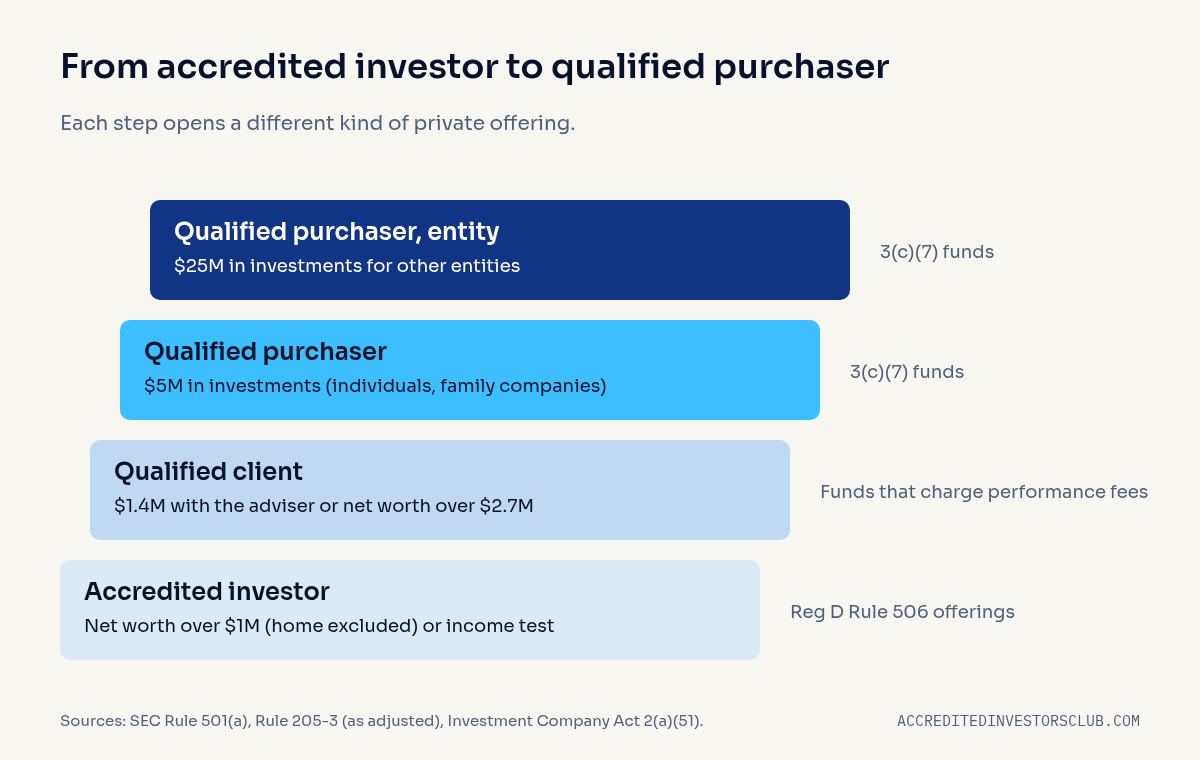
| Qualified client | At least $1,400,000 under management with the adviser, or net worth over $2,700,000 | Funds and advisers that charge performance fees |
| Qualified purchaser | At least $5,000,000 in investments (individuals and certain family companies) | 3(c)(7) funds |
| Qualified purchaser, other entities | At least $25,000,000 in investments | 3(c)(7) funds |
Accredited investor thresholds
The accredited investor standard is the baseline for participating in most private placements under Regulation D. You can check your own standing using our Who Qualifies as an Accredited Investor? A Welcoming Guide or the Accredited Investor Test Calculator.
Under federal rules, an individual qualifies through net worth, income, or specific professional credentials:
- Net worth test: A net worth over $1,000,000, either alone or jointly with a spouse or spousal equivalent. Your primary residence is excluded from this calculation. Mortgage debt on your primary home up to its fair market value does not count as a liability, but debt exceeding the home's value or debt added within 60 days of the investment does count.
- Income test: Individual income over $200,000 in each of the two most recent years, or joint income with a spouse or spousal equivalent over $300,000, with a reasonable expectation of reaching that same level in the current year.
- Professional licenses: Individuals holding the Series 7, Series 65, or Series 82 securities licenses in good standing.
In his book on private markets, Richard C. Wilson writes that private equity funds pool capital from these qualifying investors to acquire operating businesses and diversify holdings.
Entities can also qualify as accredited investors. Corporations, partnerships, LLCs, and trusts qualify if they hold total assets over $5,000,000 and were not formed solely to buy the securities. Any entity where every equity owner is an accredited investor also qualifies. As a speaker at a Family Office Club event explained, family offices with over $5,000,000 in assets under management and their family clients qualify under these provisions. In addition, fund managers may accept knowledgeable employees of the private fund into that fund's offering.
Qualified client thresholds
The qualified client standard applies primarily to registered investment advisers charging performance-based fees. If a private fund manager charges carried interest or an incentive fee, investors usually must meet this standard under Rule 205-3.
To qualify, you must meet at least one of these two financial tests:
- Assets under management test: At least $1,400,000 in assets under management with the investment adviser.
- Net worth test: A net worth over $2,700,000, calculated alone or jointly with a spouse.
Like the accredited investor calculation, your primary residence and associated ordinary mortgage debt are excluded from the net worth test. For an in-depth review of how these rules govern advisory arrangements, see our guide on Qualified Client Status and Performance Fees.
Qualified purchaser thresholds
The qualified purchaser standard is the highest individual threshold. It is defined under Section 2(a)(51) of the Investment Company Act and applies mainly to larger private funds. You can read more about these funds in our guide to 3(c)(1) vs 3(c)(7) Funds: What It Means for You.
The qualified purchaser requirements focus on investments owned rather than general net worth:
- Individuals and family companies: Natural persons and certain family-owned companies owning at least $5,000,000 in investments.
- Institutional entities: Entities acting for their own account or other qualified purchasers that own and invest on a discretionary basis at least $25,000,000 in investments.
Investments include stocks, bonds, private securities, real estate held for investment, and cash reserves, but exclude personal assets such as your personal residence. To explore how this standard operates in practice, visit our guide on Qualified Purchaser: The Next Step Up.
The table on this page outlines how these three tiers compare across net worth, income, asset minimums, and permitted fund structures.
Frequently asked questions
Can my partner and I combine income if we are not legally married?
Yes. The SEC rules permit combining income with a spousal equivalent. A spousal equivalent is defined as a cohabitant occupying a relationship generally equivalent to that of a spouse. You can qualify with joint income over $300,000 across the two most recent years with a reasonable expectation of reaching the same level in the current year.
Does equity in my home help me reach the net worth threshold?
No. Under federal rules, your primary residence is excluded as an asset when calculating net worth for accredited investor or qualified client status. Any mortgage debt up to the fair market value of the home is also excluded from your liabilities.
What is the main difference between an accredited investor and a qualified purchaser?
An accredited investor needs over $1,000,000 in net worth excluding a primary residence, or $200,000 in annual individual income. A qualified purchaser needs at least $5,000,000 in investable assets. Accredited investors can access standard private placements, while qualified purchasers can participate in larger private funds exempt under Section 3(c)(7).

Related reading
- Accredited Investor Test Calculator
- Net Worth Calculator Excluding Your Primary Residence
- Qualified Purchaser Investments Calculator
- Qualified Client Test Calculator
- Preferred Return and Waterfall Calculator
- Capital Call and Liquidity Planner
This site is built from over 19 years of Family Office Club workshops, bootcamps, masterminds and investor events. The club has 17 million registered LinkedIn group members, 19 million social media followers in total, 345 events held and $1B in transactions completed between our members.
Sources
- Family Office Club investor event
- Private Equity, a book by Richard C. Wilson
- SEC Rule 501(a), definition of accredited investor (eCFR)
- SEC Rule 506 (eCFR)
- SEC: Accredited investors
- SEC Rule 205-3, qualified client (eCFR)
- SEC Rule 2a51-1, qualified purchaser investments (eCFR)