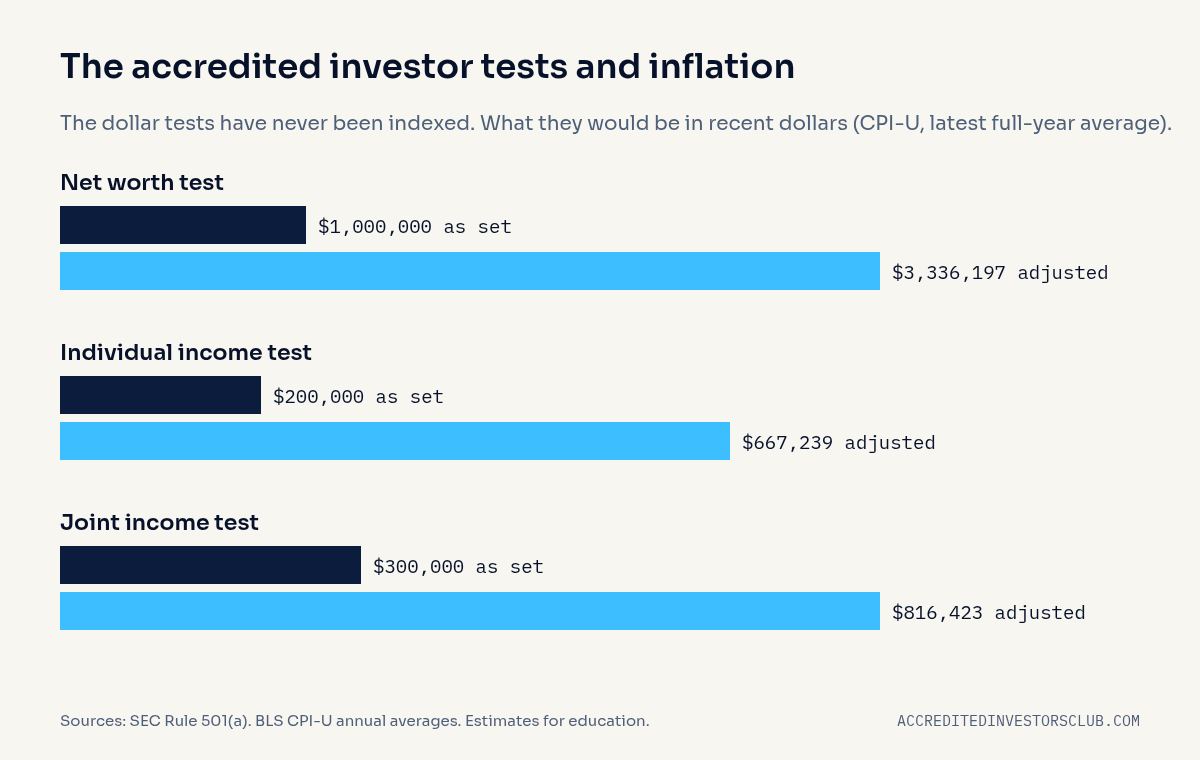
| Test | Amount in the rule | Set in | In recent dollars (CPI-U) |
|---|---|---|---|
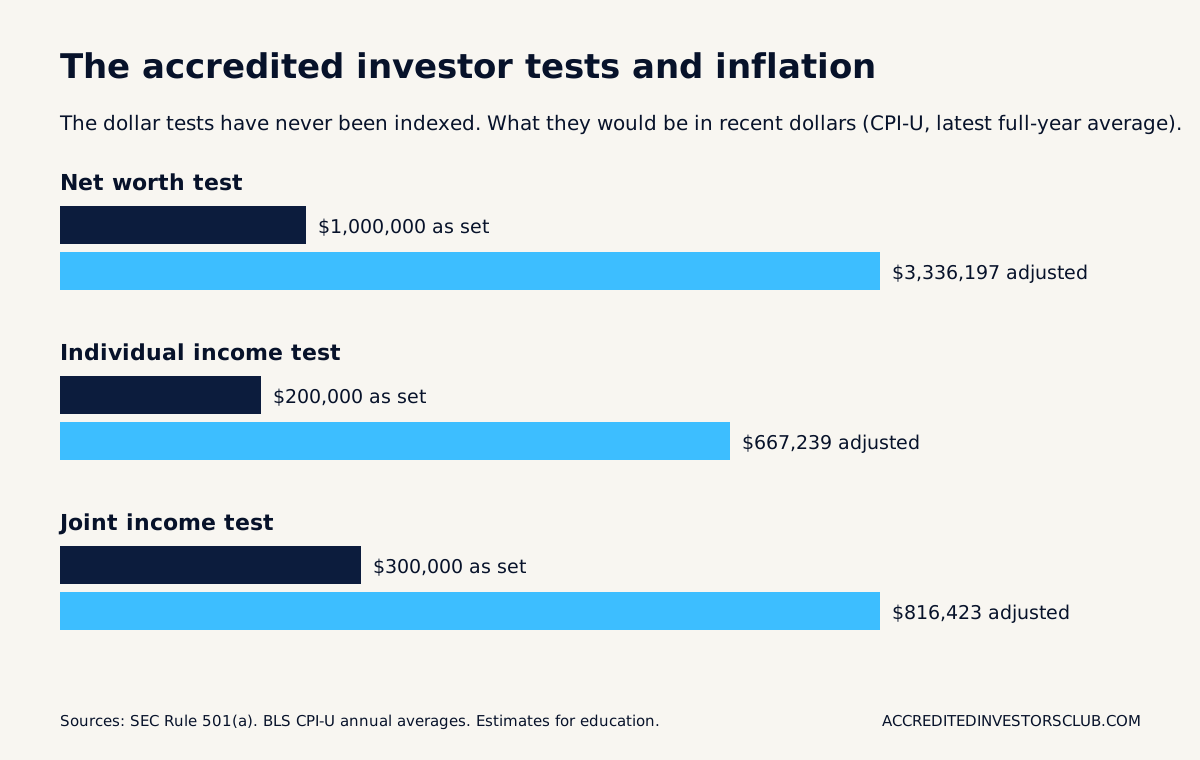
| Net worth, excluding primary residence | $1,000,000 | 1982 | $3,336,197 |
| Individual income | $200,000 | 1982 | $667,239 |
| Joint income | $300,000 | 1988 | $816,423 |
Recent dollars use the latest full-year CPI-U average from the Bureau of Labor Statistics. The rule amounts have not been indexed for inflation.
The History of Fixed Financial Thresholds
The individual financial tests for accredited status rely on fixed dollar amounts. An individual qualifies with a net worth over $1,000,000, either alone or jointly with a spouse or spousal equivalent. When calculating this net worth, your primary residence is excluded as an asset. Mortgage debt on the primary residence up to its fair market value is not treated as a liability, though debt exceeding the home's value or debt added within the prior 60 days outside of purchasing the home does count as a liability.
For the income standard, an individual must earn over $200,000 in each of the two most recent years, or over $300,000 jointly with a spouse or spousal equivalent, alongside a reasonable expectation of reaching the same income in the current year.
These dollar benchmarks have never been adjusted upward for inflation. The net worth and individual income figures were originally established in 1982, and the joint income test was added in 1988. While the Dodd-Frank Act required the exclusion of the primary residence from net worth and mandated regular four-year reviews by the Securities and Exchange Commission, the headline dollar thresholds remain unchanged. You can review the exact criteria in Who Qualifies as an Accredited Investor? A Welcoming Guide.
How Inflation Has Expanded Investor Eligibility
Because general wage growth and asset values rise over time, the purchasing power represented by these fixed thresholds has shifted. An income of $200,000 or a net worth of $1,000,000 represented a much smaller, more concentrated group of households decades ago than it does today.
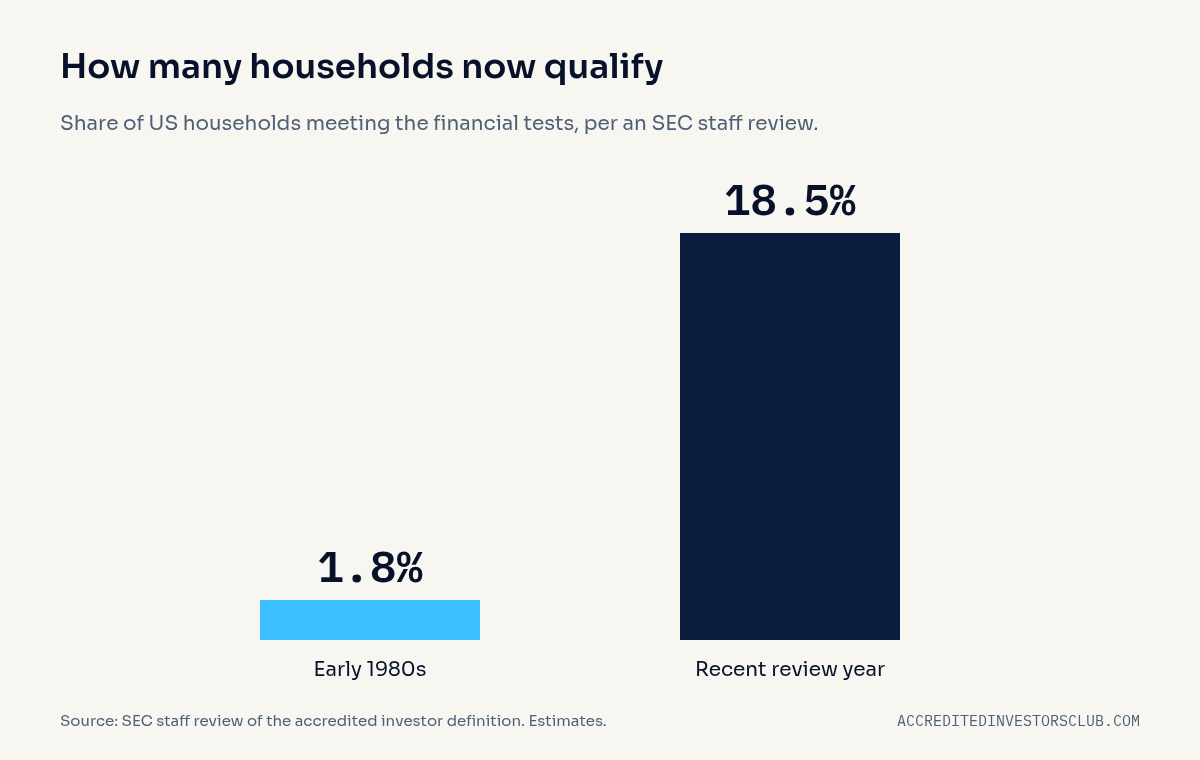
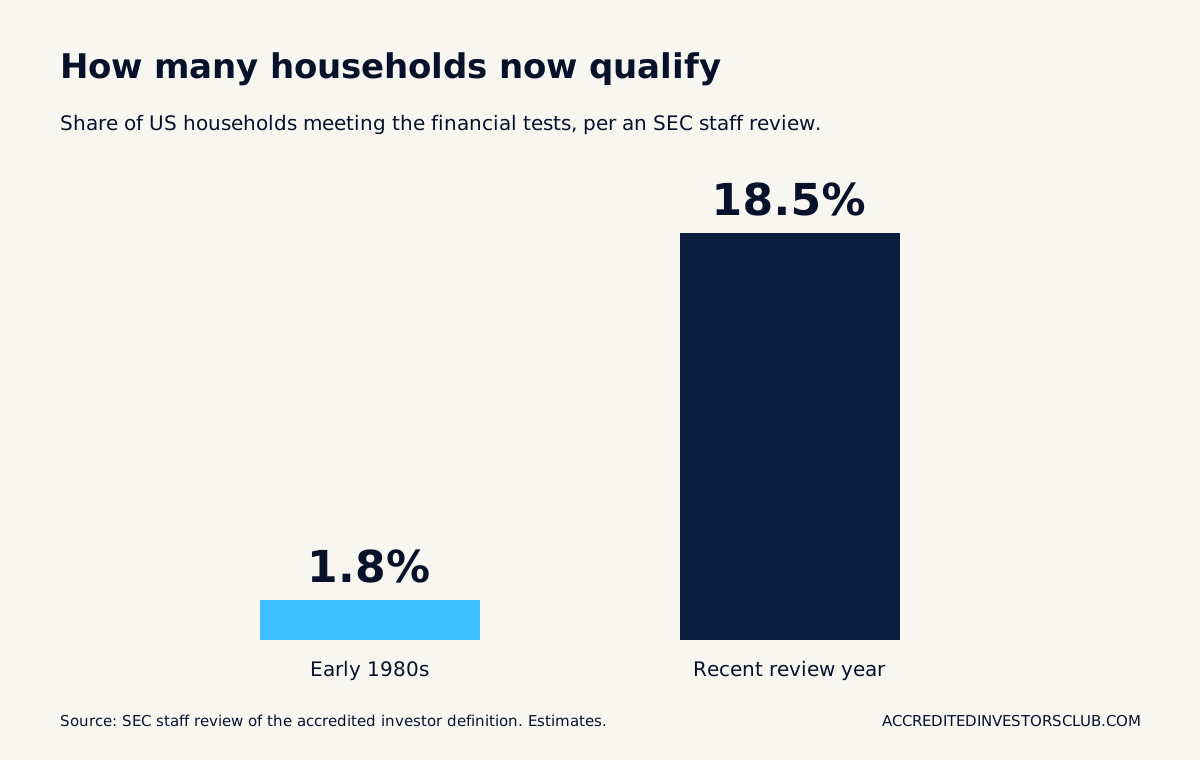
An SEC staff review of the accredited investor definition estimated that approximately 18.5% of US households qualified under the financial thresholds in 2022. By comparison, only about 1.8% of US households qualified in 1983.
The chart on this page illustrates the growth of qualifying households across the country over the past four decades. As inflation gradually lifts nominal incomes and investment portfolios, millions of additional families, professionals, and retirees now satisfy the basic net worth and income standards. You can test your own numbers using the Accredited Investor Test Calculator.
Investor Priorities in an Inflationary Environment
While static rules allow more individuals to access private offerings, inflation also influences how private capital is allocated. At a Family Office Club event, a speaker explained that private investors generally focus on three fundamental goals when placing capital. First, they focus on the preservation of capital to avoid losing principal. Second, they seek the long-term growth of their capital. Third, they actively seek investments that can hedge against inflation.
Hedge Fund Group's portfolio analytics notes explain how sophisticated investors analyze return distributions and manage risk across varying market conditions. When evaluating opportunities, investors often look beyond baseline public markets to private equity, real estate, and direct ventures to preserve their purchasing power against inflation.
Frequently asked questions
Do the accredited investor thresholds automatically adjust for inflation each year?
No. Unlike certain other regulatory definitions, the individual net worth threshold of $1,000,000 and the income thresholds of $200,000 individual or $300,000 joint are fixed dollar figures and do not adjust automatically with inflation.
How does the qualified client threshold compare regarding inflation?
Certain other regulatory standards do adjust periodically. For example, the qualified client threshold under Rule 205-3 requires at least $1,400,000 under management with an adviser or a net worth over $2,700,000, reflecting inflation adjustments from previous levels.
Does inflation change the requirements for entity qualification?
Most entity types, such as corporations, partnerships, and standard trusts, must hold total assets exceeding $5,000,000 to qualify. Like the individual net worth tests, this $5,000,000 asset requirement is a fixed statutory amount that has not been indexed for inflation.

Related reading
- Accredited Investor Test Calculator
- Net Worth Calculator Excluding Your Primary Residence
- Qualified Purchaser Investments Calculator
- Qualified Client Test Calculator
- Preferred Return and Waterfall Calculator
- Capital Call and Liquidity Planner
This site is built from over 19 years of Family Office Club workshops, bootcamps, masterminds and investor events. The club has 17 million registered LinkedIn group members, 19 million social media followers in total, 345 events held and $1B in transactions completed between our members.
Sources
- Family Office Club investor event
- Family Office Club library reference text
- SEC Rule 501(a), definition of accredited investor (eCFR)
- SEC: Accredited investors
- SEC Rule 205-3, qualified client (eCFR)
- SEC Rule 2a51-1, qualified purchaser investments (eCFR)
- SEC staff review of the accredited investor definition
- BLS Consumer Price Index